Author Archive

By: Jonathan Baker

Most courses ranked atop America’s 100 Greatest Golf Courses have a special component to them. Something intangible that you don’t necessarily expect until you play there. Maybe it’s the history, the grounds, the exclusivity, the views, the course conditions. Whatever it is, it creates an aura around the entire experience that makes you float mindlessly, yet remember everything.

Golf as it was meant to be played: Merion East. Photo credit: Golf Digest.

I’ve been lucky enough to have this happen a few times. It’s come along the Pacific cliffs at Cypress Point, amid the azaleas at Augusta, and most recently among the white faces and wicker baskets at a course that embodies the true essence of golf’s golden age: Merion Golf Club.

Situated among the well-healed neighborhoods along Philadelphia’s Main Line, the Merion Cricket Club was founded in 1865, a sporting playground for the Philadelphia elite. By 1896, a golf contingent had emerged from the membership and with it, an 18-hole course on the club grounds in Haverford. A decade into the 20th century, Merion turned to Scotsman Hugh Wilson, to design and build a new course on acquired land in nearby Ardmore. By September of 1912, Merion Golf Club’s East Course opened for play, and was instantly hailed among experts, “the finest inland links in the country.” Read the rest of this entry »

  • Share/Bookmark

Masters week is here which means Christmas-morning-like excitement for golfers world-wide.

The Masters Tournament is the best viewing experience in sports, there’s no question. What makes it the venue, experience, and tradition like no other? The legacy of Bob Jones.

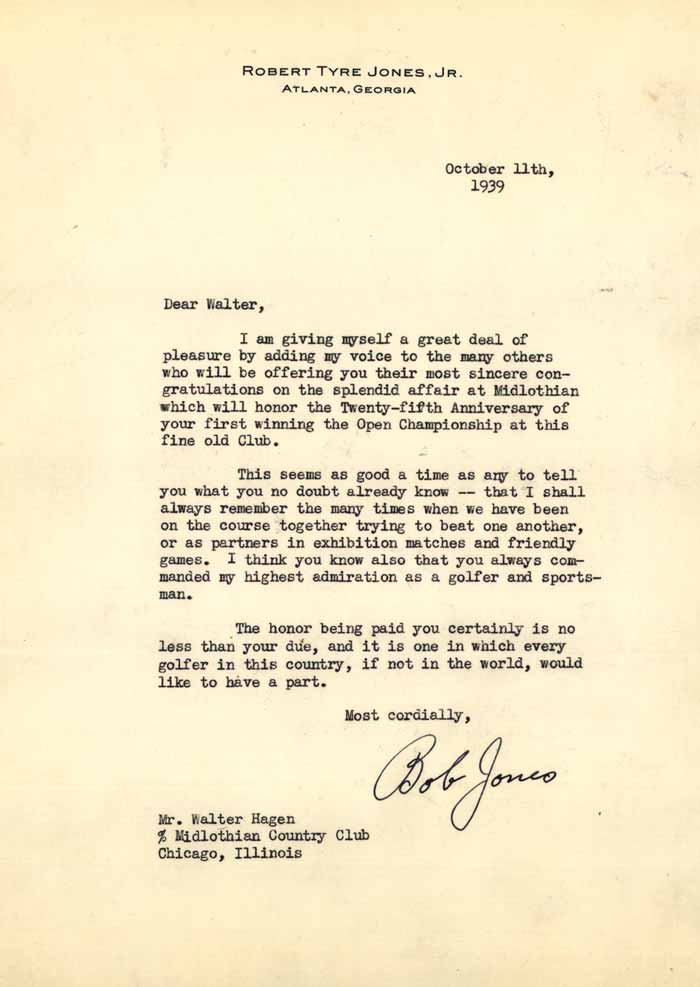
There’s a reason Bobby Jones’ polite portrait is displayed in the locker rooms of Peachtree Golf Club, East Lake Golf Course, Merion Golf Club, Augusta National Golf Club, and hundreds of clubs throughout the world. The game of golf is played by the most powerful men in the world: money, power, and achievement is attained by many players of our sport. However, earning our society’s highest accomplishments while maintaing humility, tact, and grace was never performed better than Bob Jones. No CEO, politician, or athlete will ever achieve Mr. Jones’ status in society while maintaining his level of humility. It’s impossible to put in words.

Pictures and his words are all we have now.

Read the rest of this entry »

  • Share/Bookmark

There’s something comforting about having a golf club only a few paces away. The office, the living room, or even a lightly trafficked hallway are all locations where I’ve received enjoyment from its mere presence. Then, to stand over it, take a few putts or practice swings with your work attire or gym clothes on keeps the game familiar and fresh even in the most unsuspecting times of the year. As we all ramp up for this golf season, a good way to start is by taking one club out of the bag and put it somewhere you frequent often. You’ll get more inspiration from the club being in your hand than any book, article, or blog could ever assemble.

Jon @ atruegolfer.com

  • Share/Bookmark

Golf photography is unlike any other sport. There are so many facets to it – the style, emotion, scenery – it’s fascinating, yet overwhelming. A golf photo has versatility. For instance, there are golf photos appropriate for the guest room bathroom, then there are photos for the living room and if daring enough, the dining room. Regardless of style or taste, each photo has a place in a golfer’s home. This post shares 7 golf photos and where they could go in your house.

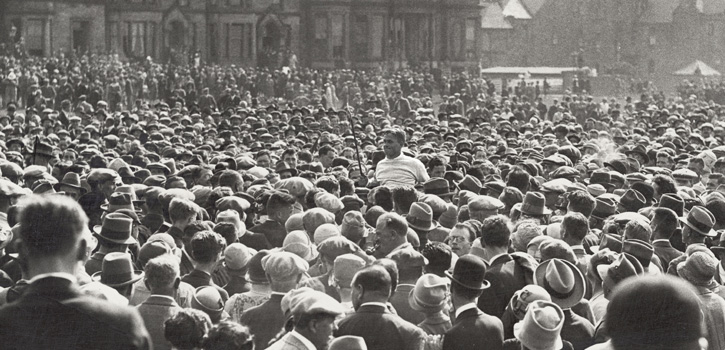
Bobby Jones, 18th hole at St. Andrews: “Carried Like a King”

In 1930, the year Bobby Jones won the Grand Slam, the British Amateur was held at St. Andrews. Below is a picture of Bobby Jone being hoisted by the crowd as he holds up his famous putter, Calamity Jane. Bobby became such a crowd and city favorite, in 1958, he was awarded with the Freedom of St. Andrews. The only other American bestowed with such honor was Benjamin Franklin. Watch his acceptance speech here.

Place in the house for “Carried Like a King:” – The Smoking Room. Read the rest of this entry »

  • Share/Bookmark

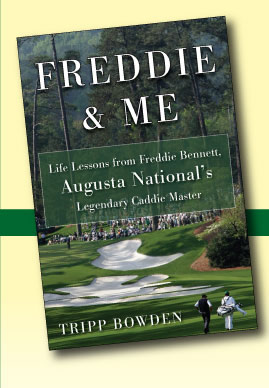
I’m convinced there are not enough golf books in this world. Millions of fantastic golf stories are untold because they were never journaled. Fortunately for the golf world, Tripp Bowden chronicled his experience as one of the first white caddies at Augusta National Golf Club. His book, Freddie and Me, takes the reader inside the grounds of Augusta National Golf Club and tells stories from the club with Freddie Bennett — the revered caddie master of 30+ years — as the focal point.

Freddie and Me touched on many of life’s greater observations. Tripp was kind enough to answer my follow up questions about Freddie, the course, and golf. Read the rest of this entry »

  • Share/Bookmark

As we enter a new year, I thought it interesting to recollect on the zen of Ben Hogan. There are hundreds of stories that depict Ben Hogan as a man of many sides: harsh, determined, exact, closed, detailed, mysterious and even humorous — in the right circles.

Regardless of popular perception, there is arguably no other man in the history of the sport who understood his game and golf better. Except for a few films, interviews, and one of the most popular instructional books, Hogan left us little to study. This post is focused not so much on the tangibles he left, but more on what we can learn from the golfer and man that was Hogan and how we can apply it to our game and life.

Have clear motivation early on.

In a 1987 Golf Magazine Interview, Hogan was asked, “What was it that drove you so hard? His answers were clear and short:

“Three things. One, I didn’t want to be a burden to my mother. Two, I needed to put food on the table. Three, I needed a place to sleep.”

Hogan was $86 dollars away from giving up the game. Luckily for the golf world, he earned a couple hundred dollars that week and his career continued.

After he became settled and more comfortable financially, he didn’t allow for life’s luxuries to deter his focus.

GOLF Magazine: Once you and your family were eating well and sleeping comfortably, then what drove you?
HOGAN: Pride. Determination. I saw an opportunity. And when you see an opportunity, you practice and work, at least from sunup to sundown. Read the rest of this entry »

  • Share/Bookmark

I find it fascinating when celebrities represent certain brands. So, there was great pleasure when I came across a 1960′s commercial starring Dean Martin sponsoring Dino’s Golf Balls. However, there was no question as to why Dean Martin would sponsor this brand because it was his own line of golf balls!

The production is classic. The Ventures’ Hawaii Five-0 plays while Martin’s facial expressions and antics of frustration finally reside after hope transitions into joy — all in under a minute.

The most surprising piece of this commercial is the customer satisfaction guarantee and return policy after they’ve been used. The voice over states:

“Try one. If you don’t agree, return the dozen and get your money back. Exclusively at White Front Stores.”


Of course we can’t leave this post without displaying some of the talent and charisma that made Dean so successful. Below is him singing “That’s Amore.” Enjoy!


Who is your favorite celebrity that has represented a golf brand or company?

  • Share/Bookmark

The game and cigarettes have always had an interesting relationship. After reading Bernard Darwin’s essay titled The Golfing Cigarette, a post was warranted. Growing up, cigarettes were a part of my experience – the long drag remains in my father’s pre-shot routine.

In Darwin’s essay, he conveys 5 (of many) different types of cigarettes on the golf course. They are:

  1. There is the one that a man lights on the tee just to steady him and help him over the first hole.
  2. There is the one, particularly applicable to medal rounds, which follows a disaster in a bunker leading to a six or a seven.
  3. There is, in a match, the one that is felt to be absolutely necessary when a nice little winning lead of three up or so has suddenly been reduced to a single hole.
  4. There is the cigarette to be smoked at the turn, irrespective of the state of the game, but because the turn is a definite occasion and an occasion calls for tobacco.
  5. Finally and most blissful is the dormy cigarette…

Golf and cigarette’s relationship has been like any other; good times and bad times ebb and flow. In the early years of competitive golf, it was viewed as disrespectful to smoke in a match. Americans slowly morphed the perception as even the great Bobby Jones took a few drags during critical moments.

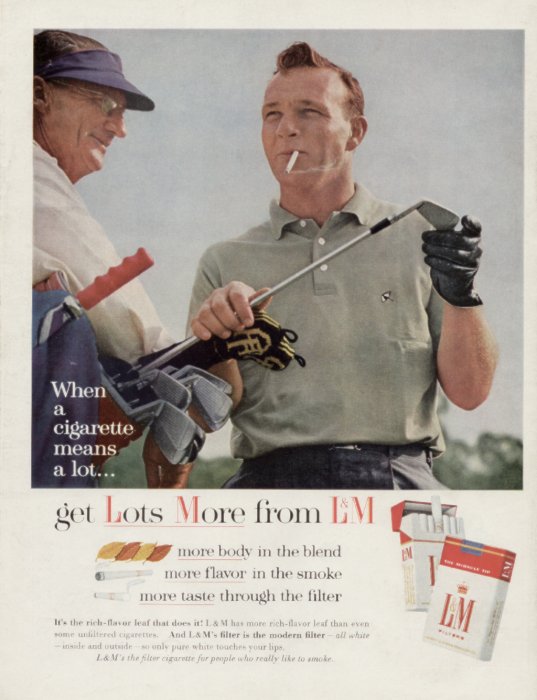
Unquestionably the pinnacle of golf and cigarette’s relationship was during the commercialized boom years of golf. The years of post-war golf seemed to curb the stigma and when the likes of Ben Hogan and others made it a habit, the act was more accepted; proven by the King’s promotion of LM’s (image below).

The relationship of cigarettes and golf today is still strong, but more subtle. Although, an opponent lighting up a Camel is in no sign of disrespect, it’s more likely to be perceived as a weakness. Vernacular has even changed. Smoking cigarettes, is no longer called smoking cigarettes, but ‘ripping nails’ is just as easily interpreted in the golfing elite’s terminology.

Cigarettes and golf will always be married together. Both need each other: cigarettes because without golf, there would be less moments needed for them, and golf, because without cigarettes, the game would be that much more difficult.

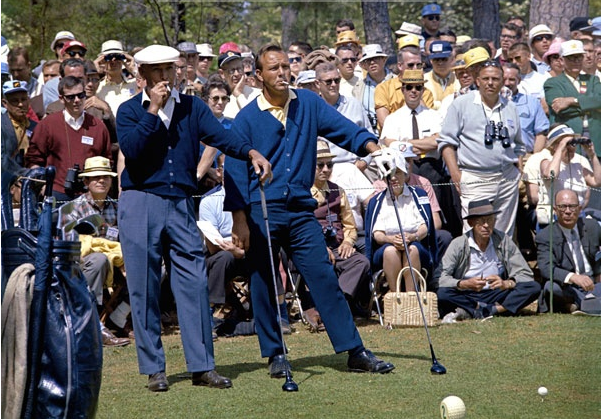
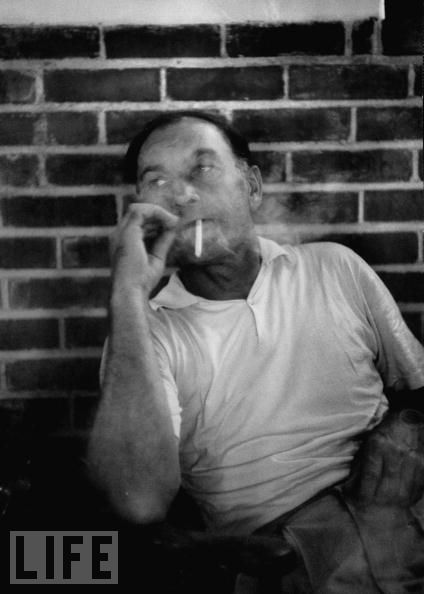
Arnold Palmer and Ben Hogan smoking cigarettes before their shot.

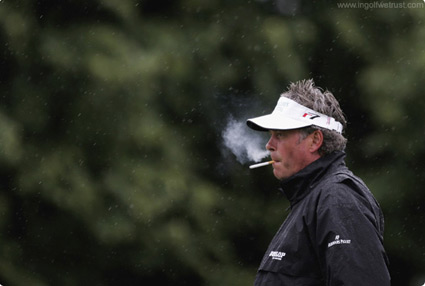
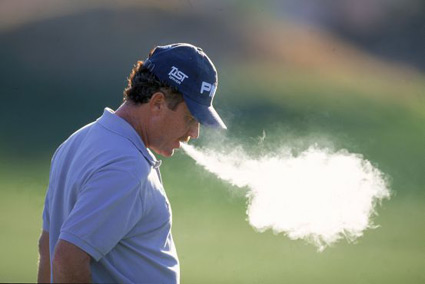
Darren Clarke smokes a golfer's cigarette.

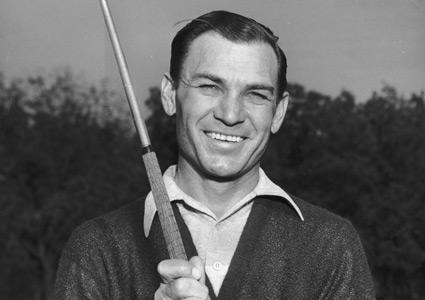
Post-round cigarette for Ben Hogan.

Miguel Angel-Jimenez smokes cigarettes and cigars.

Arnold Palmer promoting LM's.

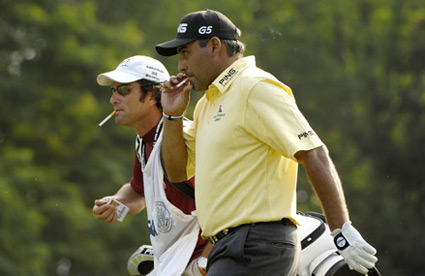
Angel Cabrera is one of the most prolific smokers on tour.

  • Share/Bookmark

The Ryder Cup: it’s brilliant, it’s patriotic, it’s a rare moment of bonding that the game rarely shows. For one week, the world’s best from the U.S and Europe team up and compete in a dazzling biennial affair. Hosted this year in the U.S. at Medinah Country Club, outside of Chicago, the golf world will be watching as Europe tries to defend the title and keep the cup overseas. Below are 5 videos every golfer should watch before the first stroke is struck. Each video has been selected to emphasize the emotion, patriotism, and strategy all intertwined into a tournament unlike any other: The Ryder Cup.

Context behind the Ryder Cup:

Before 1985, the U.S. had dominated the Ryder Cup only losing three times since it’s inception in 1927. However, in 1985 the tides began to turn with the help of young, charismatic golfers like Seve Ballesteros, and the competition has never been same since. Below is a chart showing which teams won, by how much, and who lead the team to victory and defeat.

Read the rest of this entry »

  • Share/Bookmark

The indepth, benevolent interrogation by Charlie Rose doesn’t escape the game we know and love. When I heard that Tom Watson would be on the other side of the round, oak table I knew it would be something to TiVo. Below is the 32 minute interview and the summary that follow.

- Charlie opens the interview with a look back at Watson’s chip-in on the 17th at Pebble.

- Watson truly believed he could win the Wednesday night before the start of the tournament.

- His example of what makes his experience beneficial is fantastic; trust and confidence in the course made his 6 prior experiences at Turnberry such an advantage.

- Watson on links golf “That’s links golf, you just don’t know.”

- Tom’s hatred of failure is what drove him to succeed.

- The caddy-player relationship in Watson’s life is amazing. Bruce Edwards spent over 30 years on the bag with Watson.

- When the ball was in the air on 18 at Turnberry in 2009, Watson thought it would be 77′ all over again.

- Watson’s major motivation for great play at the Masters this year was his son being on the bag.

- To be great at anything, you’ve got to have conviction that you’re great. Tom believed that.

- Everyone always talked about Jack and his strategy around the course. Watson puts it in much simpler terms by saying, “Jack was the best at taking the element of risk out of an individual shot.”

Two Questions Watson Asked Hogan: it surprises me that Tom only met Ben once.

- Do you ever think a tall golfer will ever be one of the best players?” Hogan responded by saying “Absolutely.”

- How nervous did you get when you were playing in competition? Hogan replied, “Tom, I was so nervous I was jumping out of my skin.”

- Charlie asks “Why would you wake up and not warm-up well if you in the lead?” A simple question, but yet, it cuts to the heart of the enigma is that is the game of golf. Watson replies that is just the way the the game is and feel is such a big factor.

- The snowball effect of losing confidence happened to Tom midway through his career.

Watson finds “it.”

- His practice session on the range in 1994 is where Tom Watson discovered his secret. There are many similarities to Tom’s secret and the one of Ben Hogan.

- Wow, did not know Tom Watson thought about quitting the game.

- Learn from the best through observation.

- Watson equates ball striking to pitcher’s and their control of the movement of their pitch.

- The modern golf swing is epitomized in Sam Snead’s swing.

Jon @ atruegolfer.com

  • Share/Bookmark